


Part II: Broken Wing — On Kindness, Sight, & the Strain of Flight
Introduction
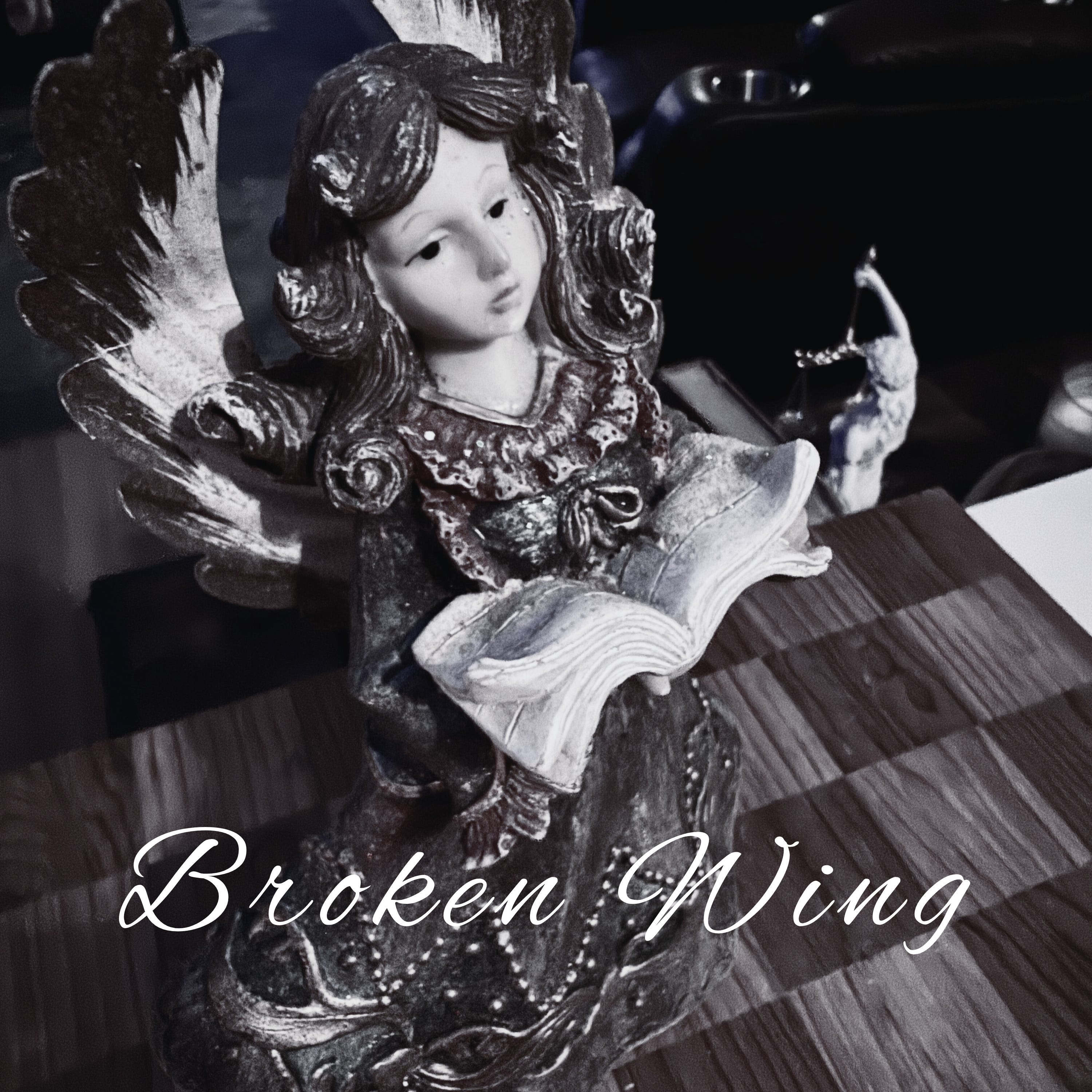
This weekend, while decorating for Christmas, I found the old angel my family has had since my first year of my marriage—twenty-two years ago (shown above). She’s been unpacked and repacked countless times, but this year one of her wings was fully cracked, split in a way that wasn’t there last December.
I felt the metaphor immediately.
My marriage is in that same place now, no longer subtly strained but openly broken. My husband and I are separated and moving toward divorce, trying to navigate the transition gently for our children, including one who’s still relatively young. It’s a complicated grief—the end of a relationship yet not the end of love, the end of a story yet not the end of a family. It’s an unraveling that feels both deeply personal and strangely archetypal, like a pattern that has been slowly forming beneath the surface for years and has finally revealed itself in the open.
Part I of this blog, Through Soul’s Eyes, explored the intuitive, interior work of truth and transformation. Since writing that piece, the sight of the broken wing on Saturday has lingered and began echoing into larger questions. The metaphor has shifted—from something personal to something more expansive and outward-facing. Wings break in many ways—in private relationships, in spiritual life, across generations, and across entire societies. The cracks that appear in one part of our experience often illuminate the fractures in another.
If Part I was about learning to see myself honestly, Part II asks what it means to see others honestly—across political identities, social positions, and the vastly unequal histories that shape perception. Though it began as a symbol of heartache, the broken wing became something more. It became a way of understanding why some people seem effortlessly kind while others carry a sharpness that is often misunderstood. Why some move through life as though their wings have never carried weight, while others learn to fly with fractures no one notices.
This reflection isn’t about blame. It’s about perception, privilege, pain, and the different ways people rise or remain grounded by the weight they’ve carried. It’s the second wing of the same bird, the outer journey that mirrors the inner one.
Learning to see ourselves clearly is the first step. Only then can we offer compassion outward—rising beyond the old patterns of fear and ego.
Broken Wing: On Kindness, Sight, & the Strain of Flight
Kindness is often treated like a fixed trait, a moral badge, a shorthand for who we believe people are. I’ve heard it said that one political group is generous and warm while another is angry or cold, as though compassion and sharpness fall neatly along ideological lines. Human behavior is never that clean. Our actions are shaped by who we are, where we come from, and how the world has or has not met our humanity.
Our identities shape how we see others—and how others see us. Race, class, gender, sexuality, religion, citizenship, and ability are all lenses through which we experience the world. For some, the world reflects familiarity. For others, it reflects distortion or erasure. That asymmetry alters our entire emotional landscape. It changes what feels kind, what feels dangerous, and what feels like survival.
Someone recently told me that in their experience, conservatives seemed more generous—offering open homes, shared meals, and a readiness to give you the shirt off their back. Liberals, in their experience, seemed sharper, less outwardly friendly. There may be truth in that observation, but there are deeper layers at play—layers tied to culture, history, and the invisible architecture of power.
I grew up in a small rural town in New England. I know the warmth of small communities—the generosity that emerges when the rhythm of life depends on neighbors helping each other. I also know how easily that warmth becomes conditional. It’s often extended most freely to those who reflect the community’s own identity—those who fit the familiar story of who belongs. It can be deeply loving and deeply limiting at the same time.
Kindness grows in soil shaped by history and narrative. When your wings have never been broken, it becomes difficult to imagine the strain others carry just to stay airborne. Weight does not always come from hardship alone. It comes from the way identities are held or dismissed by the world. One person’s pain arrives randomly. Another’s follows the lines of history.
Warmth often associated with conservative communities tends to flow most easily toward those who resemble the community itself—white, Christian, straight, cisgender, citizen, native, and familiar. That type of kindness has a radius. From inside, it may feel universal. From outside, it can feel conditional.
Those who encounter its boundary feel the sharpness of exclusion, even when the intention was love. Hospitality, in those moments, becomes entangled with invisibility.
This pattern shapes a community’s energetic life. Conditional belonging is hard to see from the inside, yet it slowly closes energetic pathways that would otherwise remain open. Over time, it constricts the full expression of soul—until someone strong enough or awake enough begins to push back.
Niceness alone doesn’t reflect justice. Generosity without equity doesn’t reflect solidarity. It’s possible to be personally kind while supporting policies that harm entire communities. These contradictions are not hypothetical. They live in the lives of others.
Disagreement over taxes isn’t the same as disagreement over someone’s right to exist safely. These are not mirrored positions. They carry different ethical weight. Even conservatives who experience poverty often retain cultural centrality. Their pain is real, but their identity remains centered in national narratives. That kind of legitimacy provides safety others don’t have.
For those who are non-white, queer, immigrant, trans, or disabled, the fracture is often both personal and generational. Their wings have carried centuries of weight. Their cultures remember what it means to survive collapse—music that holds pain, food that remembers care, language that resisted erasure.
However, not all pain transforms. Pain that is not metabolized becomes vigilance. What appears as coldness or anger is often a refusal to mask harm just to make others more comfortable. Anger, in this context, is not cruelty. It’s the sharpness of dignity that has been ignored too long.
The question then becomes—to whom should your kindness be extended, and to whom should it be withheld? What must be overlooked to believe that personal warmth outweighs collective harm?
Perhaps the most seemingly inviting are those with an agenda least to our liking, while those with the tallest fences are the ones who truly care the most. Naming these contradictions is not hatred. It’s care. It’s an invitation to grow—to see deeply beyond appearances.
On Wings & Sight
Conservatism and progressivism are like two wings of the same bird. One wing remembers, the other transforms. Both are necessary. When either side believes it’s the whole, the body tilts. Conservatism without compassion becomes rigid. Progressivism without memory becomes reactive. Ego drives both. Ego is the mask we wear when we confuse performance with presence.
Presence is different. It’s awareness beneath the story, the clarity that survives identity. Presence allows compassion without erasing accountability. It offers truth without abandoning love.
To see with presence is to cultivate cultural intelligence. It’s to know that warmth travels unevenly. It’s to understand that power shapes not just laws and policies, but perception itself.
This is where cognitive dissonance lives—in the gap between intention and impact, gesture and history, welcome and exclusion. Kindness alone cannot close that gap. Awareness must walk with it.
When someone who has never struggled to fly offers kindness, they may not realize their ease was made possible by a world that systemically keeps others grounded. That dissonance is real—especially for those who are welcomed in words but not fully seen in truth.
Kindness that only extends so far might feel like genuine connection—but for those who’ve lived with exclusion, it can feel unsafe. Saying no or seeking clarity before accepting it, isn’t hostility.
The Broken Wing
When your wings have never broken, flight feels effortless. Cultural humility asks—Who gets to soar? Who is grounded by weight they never chose? Who is seen as whole, and who is only seen once they fall?
To live with presence is to hold these questions without defensiveness. It’s to understand that a broken wing isn’t a flaw. It’s a record of flight under pressure. It’s the truth written in the body.
Kindness, then, must be more than personality and offering alone. It must be a deeper practice and a way of listening—a way of looking and choosing to see when it would be easier not to.
The broken wing is not a symbol of despair. It’s a signal. It shows us where care is needed most. It invites a compassion that doesn’t perform.
It honors the break and the rise. It prepares the soul to mend in truth.
Broken Wing Lyrics ~ Intro
The broken wing was never just about the angel, or even my relationship—though that’s where it began. What started as personal heartbreak began to echo outward into belonging, identity, culture, and the soul of the world.
The idea grew larger than my own story. It became a symbol of the hidden weight we carry, the quiet breaks we’re taught to deny, and the fractures that split not only hearts but histories. Some move through life with wings untouched by strain. Others have learned to fly with cracks that only show in certain light.
When we begin to see one another through presence rather than ego, kindness shifts. It becomes less about niceness and more about truth. It becomes less about comfort and more about authentic connection and care. It becomes the kind of compassion that not only sees the break—but honors the rise that follows.
This, to me, is the alchemy that stirs the soul work of transformation—within ourselves and between one other.
🎻✨🪶
Broken Wing

It hurts to love you
when our love
has no place to go—
no warmth to rise,
no room to grow.

Broken wing,
spiraling slow,
soft drifts falling
like winter snow.

Found in silence
where night stands still,
memory trembles
against my will.

Eternal echoes
circle back—
soft calls returning
on a looping track.

Oh… this broken wing,
yeah, it bears the weight
when truth evades
and the heart pulls away.

Broken wing bending
under weight we made—
dreams half-remembered,
the pain that stayed.

Oh… it hurts to love you,
but the truth is wise:
some love falls silent—
yet still, I rise.

Free to break,
Free to rise

I trace the fracture
across that wing,
a fragile line
where the past still clings.

Snow keeps drifting,
chill and kind—
revealing all
you tried to hide.

Desires unspoken
rise and spill,
lingering heavy
when night grows still.

Found in silence
where love runs deep,
where the soul walks barefoot
through winter’s peak.

Eternal echoes,
soft but stern—
truth calls out,
but you don’t return.

Oh… this broken wing,
yeah, it bears our weight—
love bent heavy
from the strain we made.

Broken wing falling
like December snow;
it hurts to love you,
more than you know.

This broken wing
has nowhere to go.

Free to break
Free to rise

A wing can break
and still seem whole—
but the hidden crack
takes its toll.

Love freezes sometimes;
frost doesn’t show—
’till winter’s light
reveals the fractal glow.

Broken wings
won’t rise on command.
In light, in truth,
they must mend…

or stay grounded
where they stand.

Oh… broken wing,
when love runs cold—
feathers freezing,
wings won’t unfold.

This wound, untended,
won’t mend on its own;
some flights must end
beneath winter’s snow.

Oh… it hurts to love you—
but from this hold, released,
I’m learning to break free…

free to break,
free to rise,
finding light
that’s truly mine.

(free to break… free to rise…)
(letting go… letting go…)


