
She Rises
On the Insistence to Bloom

She Rises: On the Insistence to Bloom
There is a force alive in the world that does not ask permission.
I wrote She Rises nearly a year ago, long before I knew what this particular Easter weekend would hold. And yet here it is, arriving on Easter morning with the precision of something that was always meant to land today—the day the stone moves, the day the silence breaks, the day the tradition insists that what appeared to be the end was always, in fact, a threshold.
In the early morning hours on Friday, I wrote about dissolving into peace in the poem, Solvitur. On Saturday, I wrote about grief, in the piece, Silence Before the Stone Moves. I wrote about the ultimate sacrifice of letting go on Good Friday, about Holy Saturday and the sacred in-between, about the silence that settles over everything after a great loss—and asks us to simply remain inside it without reaching past it for relief. And now today, Easter Sunday, I’m still standing inside all of it—because healing is nonlinear. None of it diminishes or resolves completely simply because the days and nights have turned.
But I also know something else to be true, something I have felt in my own body through every season of dissolution and every difficult passage I have walked through in this life—that there is a force within us, and within the earth itself, that does not ultimately stay down. Pain can be all-consuming and immense—but life, at its most essential level, is oriented toward its own continuation and emergence.
The philosopher Spinoza called it conatus—the intrinsic striving of every being to persist in its own existence, not as an act of will but as a fundamental expression of what it is to be alive at all. The Stoics called it logos—the rational, ordering principle woven through all things, the intelligence by which the whole tends toward coherence. Neither tradition is sentimental about this. They are simply honest about what they observe when they look closely enough at how life moves.
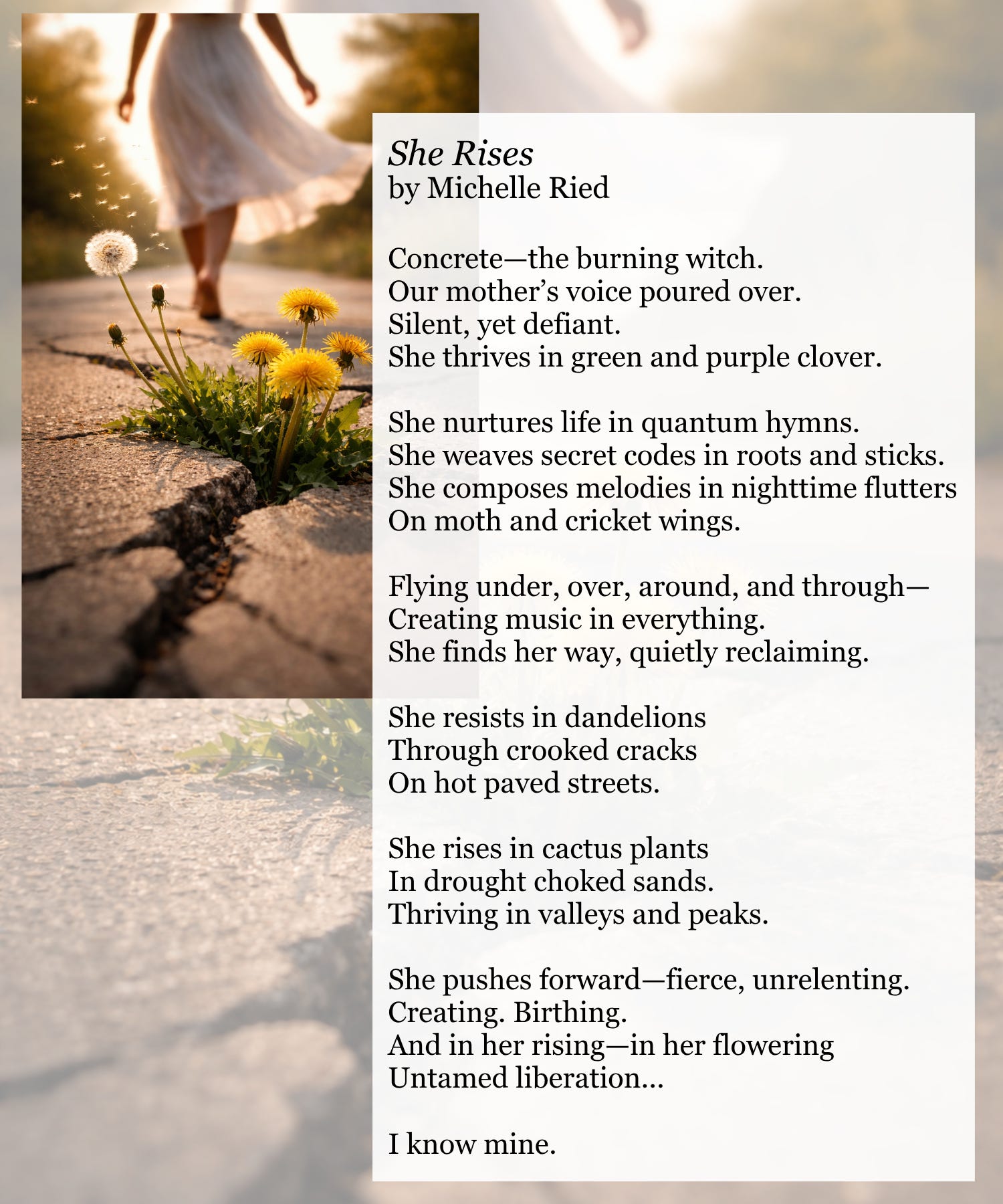
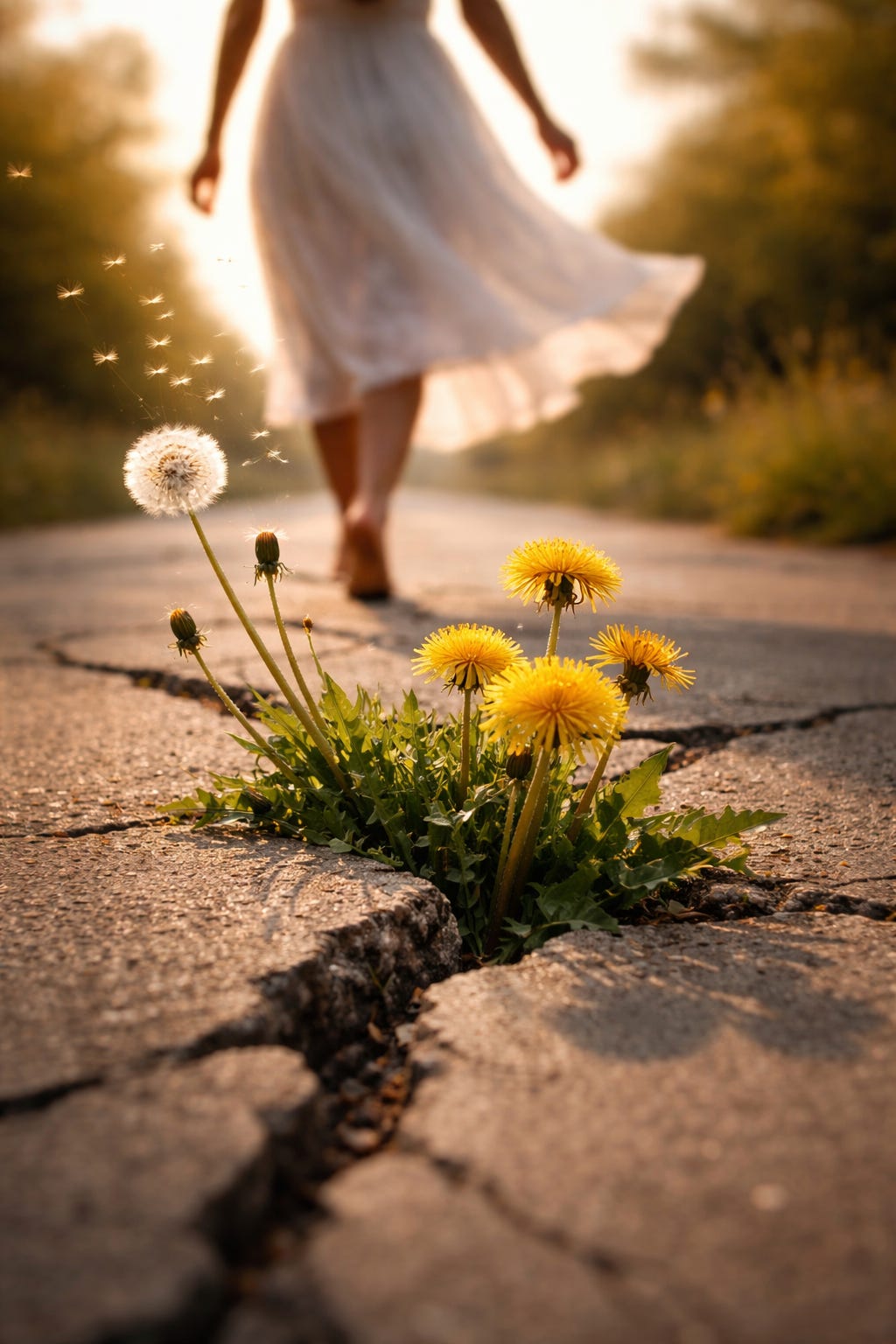
And when I look at the earth in early spring—when I watch what emerges from the concrete, what threads its way through the crooked cracks in hot pavement, what rises in drought-choked sand and floods the valleys and the peaks with something green and insistent and completely uninterested in whether the conditions are favorable—I recognize that force. I recognize it because I feel it in myself.
It’s not the absence of grief. It’s something that coexists with grief, that moves underneath it and alongside it and eventually, quietly but persistently, through it.
She Rises is written in that language—ecopoetic, feminine, grounded in the earth’s own syntax of resistance and renewal. She is the dandelion in the sidewalk crack. She is the cactus in the sand. She is the moth and the cricket and the root system threading its secret codes beneath everything we have paved over and called permanent. She is not loud about it.
She simply is.
She creates, and flowers, and rises—in her own time, on her own terms, by her own unrelenting logic.
Whatever is rising in you today—however tender it may be, however newly emerged—I want you to know that it is real, and it is yours to hold. It has always been there, waiting beneath the weight of everything you’ve carried, for exactly this moment to break the surface into light. ✨🌼✨


Love your post! So on target in the midst of all the "he is risen"... Thank you, Michelle! harold (Posted your poem on my FB page. Love it!)