
Space to Breathe
Zen, Collapse, & the Vastness of the Void

Space to Breathe: Zen, Collapse, & the Vastness of the Void
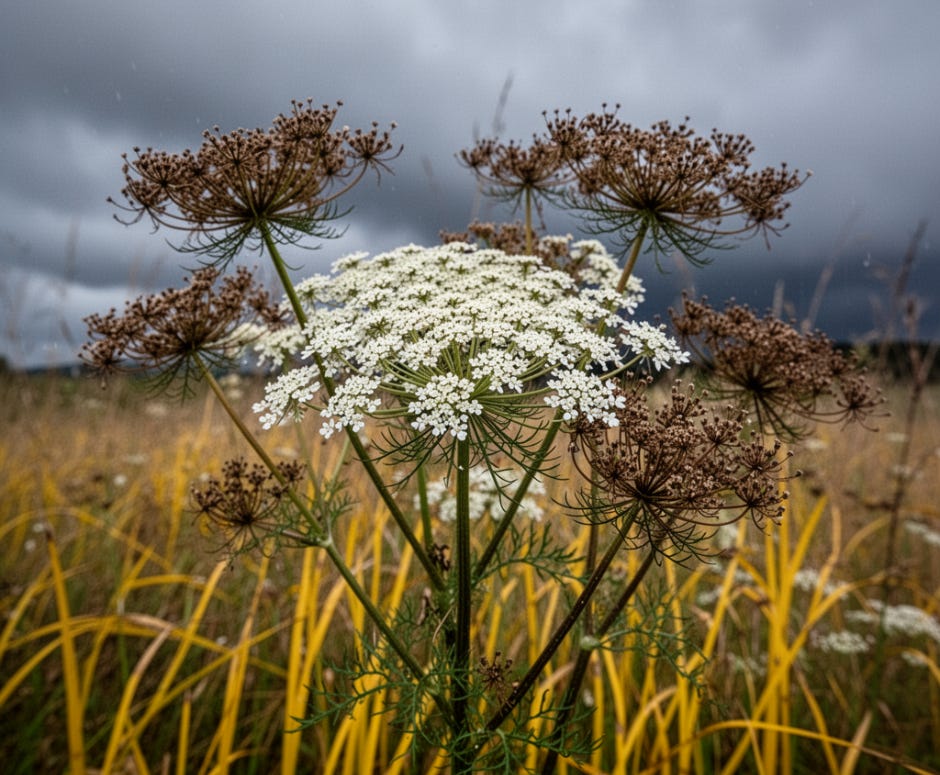
Queen Anne’s Lace is one of my favorite wildflowers. We lived in two houses throughout most of my childhood. In both places, one more country and one a little more suburban, I remember sitting in the grass just outside my bedroom window surrounded by Queen Anne’s Lace. My mother has always loved to garden and though she and my father did an excellent job of keeping up the lawn, this wildflower was persistent and grew tall before all the others.
They kept me company on cool New England days when I filled notebooks with poems and stared into the distance, looking for answers beyond the blue sky and wispy white clouds above. They befriended me on dark starry nights, as if to lean into the warmth of my heart as I yearned for understanding. They seemed to carry a cadence—a sacred, knowing rhythm of their own. I cherished them as they faded from white to umber, becoming crisp with the season.
I recall taking photos with my pink 110 camera one time as a young teenager at my parents’ house after fall brought change to the landscape. These browned wildflowers remained, standing against a backdrop of yellowed grass and a gray, woolen sky. Those have always been some of my favorite photos. I never had the right words to express why those photos spoke to me so deeply until now. Finally, at forty-eight years old, I am beginning to understand what I’ve always felt intuitively. I’m going to try to name it clearly.
Certainly, the flowers’ passing symbolized impermanence. But there is more at work here for me. For as long as I can remember, I’ve held a sense of great emptiness. I’ve felt an inner longing—an awareness of space that has felt sometimes freeing and sometimes unbearably painful.
Cognitively, I understand how depression and trauma contribute to this feeling. I understand how the pieces fit together and why my brain and nervous system function as they do. However, I’m not satisfied with those explanations alone. To me, it seems unrealized philosophical and spiritual truths live close to the root of this pain. I’ve always felt this but haven’t been able to name it clearly, until now.
I’m beginning to see this emptiness differently—not as a verdict, not as a defect, but as space: the open quality of experience itself. The same openness that can feel like painful nothingness when I brace against it can also feel like breathing room when I stop fighting for solid ground. I’m beginning not only to understand oneness as an idea, but to sense what happens when the self loosens—how life feels less like a problem to solve and more like something moving, changing, arriving.
What I had been sensing as emptiness was only half of the equation without understanding its nature. Life is seeing things as they are—and noticing the openness they arise within.
A few days ago, I listened to an Alan Watts lecture from 1959 on Zen and the void, and it helped me to further distill these thoughts. Recently, I’ve been living near the edge where my mind wants to try harder while my soul keeps asking for release—where effort starts to feel like bracing and letting go starts to sound not only appealing, but necessary.
Emptiness is usually talked about as if it’s a terrible and frightening thing. We’re trained to avoid it, to treat it like a sign something is wrong. We’re accustomed to believing that if we sense great openness, it means we are alone, failing, falling behind—and if we feel it, we must be breaking.
In Zen, the void appears as space—as openness. Silence makes music possible, stillness lets movement be seen, air gives breath somewhere to go. Experience itself needs room. Space is that simple, sacred capacity, and it isn’t sterile. It’s intimate. It’s the element that allows life to move.
Once you feel this even a little, you start noticing how much of modern life is organized around refusing it. Many of us live under a constant demand to be quick enough, calm enough, polished enough, productive enough, or just simply… enough. We end up performing coherence instead of inhabiting it. We keep moving because stopping feels like falling, and falling gets interpreted as failing—as if the nervous system’s need for rest is a moral flaw instead of a signal.
Yet we are the keepers of our own inn. We get to tell ourselves when it’s time to turn the lights out and rest. We can learn to recognize when we have done enough. We can set limits so that balance becomes possible.
And still—far too often—we are our own harshest critics. We push ourselves too far and then punish ourselves for not being able to keep pushing. We forget peace in rest, joy in simplicity, and the quiet fulfillment that doesn’t require an audience.
Success won’t be won by endless doing. Something in us knows this. Something in us keeps asking to return inward—where, in the solitude of that openness, we can face ourselves without flinching.
If we refuse that return and keep pushing as a relentless force in the world of things and doing, eventually the body tells the truth anyway. It tells it in the only language it has: fatigue, sickness, shutdown, anxiety, grief that leaks through the cracks, and a no that won’t be negotiated with.
Collapse can arrive as exhaustion, as a nervous system that can no longer cooperate, as an identity that suddenly feels foreign. Sometimes it comes with a crash. Sometimes it arrives quietly, with a steady unraveling over time. Either way, it’s easy to name it failure—especially in a culture that treats endless output as proof that you’re okay.
But I keep wondering if collapse has another intelligence inside of it—a kind of wisdom. I keep feeling an invitation threaded through the breaking, as though life is loosening what’s been bound too tight for too long. This loss of control can also be a clearing.
And when I think back to those photos, umber lace against a stone-marbled sky, I recognize the same movement—form giving way. It’s not a tragedy, it’s a cycle.
The tenderness of Zen has a clean quality to it for me. It doesn’t indulge the mind’s spirals or demand a perfect explanation before it offers relief. It simply clears the air.
In Watts’ talk, he mentions a Zen exchange that stayed with me—so I went looking for the fuller story. It comes from the T’ang dynasty: Li Ao, a government official in Langchou, greatly respected the virtues of Ch’an Master Yao-shan Wei-yen. One day, Li Ao went to visit him. The Master was reading under a tree, and though he knew Li Ao had arrived, he didn’t rise to greet him. When the attendant announced the visitor, Wei-yen simply kept reading.
Li Ao—irritated—remarked, “What I see here is not as great as what I have heard,” and turned to leave. Without warmth, the Master replied, “Why do you value what you hear and disdain what you see?” Something in Li Ao shifted. He turned back, apologized, and asked, “What is the Buddha’s teaching?”
Instead of giving him something tidy to repeat, Wei-yen pointed upward, then downward, and asked, “Do you understand?” Li Ao said no. And then the Master answered with an image so plain it feels almost like mercy:
Clouds in the blue sky; water in the jar.
At first glance it sounds like a statement of belonging. It is that. But it’s also a way of pointing to how reality moves—one spacious field, many forms. The cloud and the water are not competing. They’re expressions of the same world, changing shape in real time—arriving and dissolving without asking our permission.
When I sit with that line, I hear a request—stop pinning everything down. Stop wrestling experience into fixed conclusions just to feel safe. The sky doesn’t chase the cloud into stillness. The jar doesn’t demand the water become something else. Everything participates in its own nature, within the same shared space.
That’s what I want to offer here. It’s not a moral or a lesson to perform. It’s just this orientation I keep coming back to—we’re allowed to witness our lives in motion. We’re allowed to let feelings change shape without turning them into urgency. We’re allowed to experience the world without needing to solve it into one graspable story.
The void, in this sense, is the open field where all of it can move—grief, relief, longing, love—without us having to grasp one piece and call it the whole.
This doesn’t erase the human desire for community, friendship, love, and being understood. It changes what we do with the ache. Instead of turning misunderstanding into a verdict, we can practice something else:
Presence—
the willingness to stay with what’s here long enough for it to become honest.
Existential pain rarely arrives as philosophy. It arrives as tears and the urge to disappear. It arrives as the sense that you’re stuck behind glass while life happens somewhere else. And it often carries a bargaining voice that says:
Do whatever it takes to become unrejectable—be useful, impressive, needed, productive, easy, good. Be lovable. Be so clear no one can misread you.
That bargain can carry you far, until it can’t. One day the handrail breaks anyway. The persona exhausts itself. The story you used to stand on starts to crumble.
And then the void appears—especially when the sense of self you relied on no longer feels trustworthy—and the nervous system reacts as if it’s been pushed to the edge of something final. Zen calls it space. The mind calls it danger. But it may be something else entirely.
The void is where bracing can finally stop. It lets buried parts of you breathe. It gives your interior life a voice again—slowly, honestly, in a tempo that doesn’t require force. This is the mercy of collapse: it interrupts performance long enough for truth to re-enter the room.
Renewal doesn’t always look like triumph. Often it looks like softness where you used to be armored. Like simpler honesty. Like the willingness to be unguarded with yourself.
The middle—the in-between where the old way no longer fits and the new way hasn’t formed yet—can feel like floating. But the middle can also be a threshold: an open field where life rearranges us slowly and truthfully, without the pressure to rush for an answer. This is what I mean when I say openness can become home.
If you, like me, have been living near this edge—trying to keep up with a river that moves too fast—there is nothing wrong with your rhythm. There is nothing wrong with needing quiet to think clearly, with choosing honesty over performance, with wanting a life that doesn’t require your disappearance.
If this season feels like collapse, consider this—space isn’t an enemy. It’s what allows the next truth to arise. Clouds in the blue sky; water in the jar. Form giving way and still belonging.
Renewal comes the way it often does—quietly, steadily, with a little more breathing room than there was yesterday. ✨🙏✨


