The Sacred Interruption
How Awareness Becomes Freedom


The Sacred Interruption: How Awareness Becomes Freedom
On metacognition as the moment the actor becomes the writer
There’s a moment before thought hardens into belief—a pause before an old wound reaches for its familiar costume. A glimmer comes before the apology we never received becomes a tone in our voice, before inherited fear becomes a boundary we simply call part of our personality.
Somewhere before the old script speaks, there is still time. There is always a moment in time before the old script says: This is who you are. This is what always happens. This is how the story must go.
This is where metacognition can become a tool for liberation.
At times, we over-use the notion of self-awareness—as though noticing a pattern were the same as being free of it. But it isn’t. This essay is about that difference. It’s about how awareness becomes liberation only when it changes the next move, and about what it takes to make that crossing.
Metacognition isn’t merely thinking about thinking, though that is the easiest way to describe it.
John Flavell, the developmental psychologist who first gave the word its weight, was pointing toward something more profound—the mind’s ability to monitor itself, to know something about its own knowing, to recognize the conditions under which it remembers, forgets, interprets, predicts, and fails. Metamemory is not memory; it’s our awareness of memory’s machinery. Metacognition is not thought; it’s the balcony from which thought becomes visible.
But the balcony is not the destination.
We don’t climb above ourselves to admire the architecture of our confusion. We climb because, from that height, we can finally see the rooms we have been living in.
Some rooms were built by childhood, by grief, by systems, by silence, by love that arrived inconsistently enough to make uncertainty feel like home. Some rooms were built by betrayal, by the long labor of surviving what we thought was love—by what should have protected us.
Over time, those rooms became scripts. We learn to anticipate rejection and rehearse abandonment. We scan for danger, mistake intensity for intimacy, overfunctioning for worth, and self-erasure for peace.
We are not machines, of course—we have biological bodies with histories, human minds with weather, and souls shaped by memory and inheritance.
But we do carry many patterns, including recognition, sequence, recursion, and repair. We know how to write computer scripts because we have always been written ourselves—by family, culture, repetition, reward, shame, and even by hope.
The question is not whether we carry scripts. We do.
The question is whether we can see them before they speak for us.
Flavell described the mind’s capacity to monitor and regulate its own processes:
What do I know? What do I not know? What strategy am I using? Is it working? Should I change course? Later scholars carried this into self-regulation, executive control, and the architecture of learning.
But the simplest truth is this—awareness becomes power only when it changes the next move.
Awareness without movement becomes an endless maze of mirrors. Reflection becomes delay. We grow fluent in the language of our wounds while still living obediently inside them—naming the pattern, tracing it, theorizing it, even making it beautiful, and never once interrupting it. There is a danger here, a bureaucracy of the soul—a committee convened in the mind where no one ever signs the order to begin the work of change.
The goal is not to think endlessly about thinking. The goal is liberation.
Reflection must become an instrument, not an atmosphere to sustain. It must become how we see the script clearly enough to rewrite it. Metacognition must become integrative—it has to move from depth to design, from symbolism to structure, from I understand why I do this to here is what I am building so I no longer have to.
Contemplation and action were never enemies.
Contemplation was always meant to serve transformation.
This is where the architecture of life becomes visible.
A life is not made only of feelings. It is made of systems—habits, environments, the people we keep close, the boundaries we hold or abandon, the routines, the interpretations, the small repeated choices. If I say I want to heal but keep returning to the same relational economy that profits from my depletion, my insight has not yet become architecture. If I say I know I abandon myself but build no pause, no practice, no consequence, then awareness is ornament and not action.
The deeper work is operational. It’s where insight has to enter the body and the systems we live inside, or it stays insight forever.
The movement from awareness to freedom is not mystical in the abstract; it is a sequence.
It begins with noticing the signal—because the body knows before the mind narrates. It begins tight in the chest, in urgency, in the shame that arrives before thought. It begins in the sudden wish to disappear, or to control.
These are not failures. They are notifications, the oldest part of us tapping on the glass to get our attention.
Then we name the script, in plain words:
I am telling myself that if someone is disappointed in me, I am unsafe. I am assuming rest must be earned. I am meeting this present person as though they were an old wound wearing a new face.
Then we locate the origin without moving back into it.
Origin matters, but it’s not the whole map. This may have come from a time when love was unpredictable. True. And now—what does the present require?
Then we choose the rewrite—a single new instruction the body can follow:
Pause before agreeing. Ask one question before apologizing. Let discomfort exist without rushing to repair everyone else’s. Make no permanent decision while activated.
Then we make the boundary concrete.
We write it down. We turn it into a reminder, a morning practice, a conversation scheduled rather than dreaded, or less exposure to whatever keeps reinstalling the old program.
And then, we measure the movement.
Did I pause today? Did I recover faster? Did I tell the truth sooner? Did I need less chaos to feel alive? Did I protect my peace without abandoning my tenderness?
This is how reflection becomes repair. This is how pain becomes language, language becomes pattern, pattern becomes structure, and structure, at last, becomes freedom.
The mind can watch itself. The memory can know something of its own remembering. The self can stand inside the self and say: This is not the whole story. This is the draft I inherited. This is the scene I keep repeating. This is the line I no longer have to say.
And then, with trembling hands, we can revise.
Not all at once or perfectly, and not by pretending the old script never existed—but we revise by setting a pause where there used to be panic. We revise a boundary where there used to be resentment, a question where there used to be assumption, a practice where there used to be longing, a repair where there used to be shame, and a system where there used to be survival.
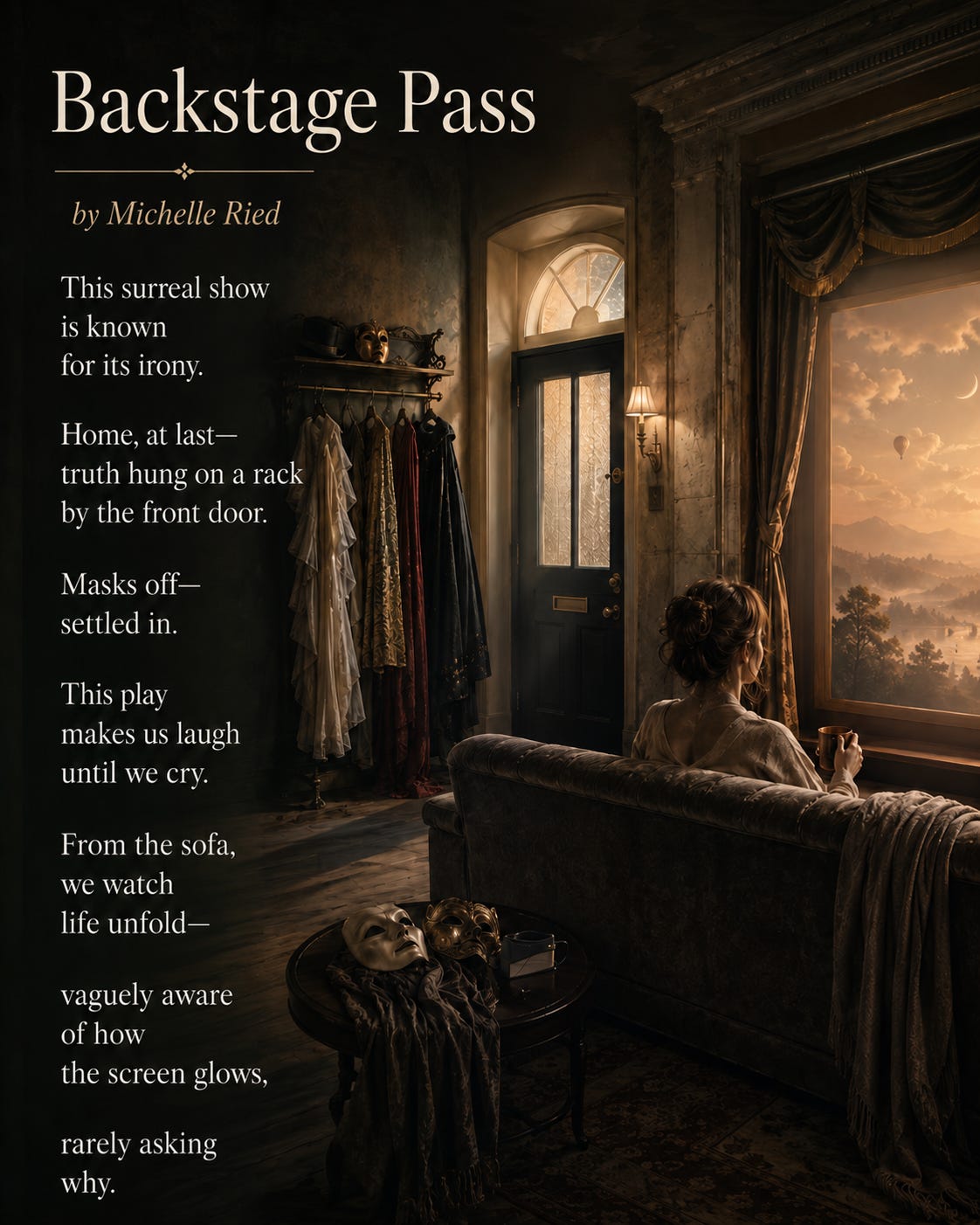
Metacognition, at its best, is not merely abstraction. It’s a sacred interruption of fate. It’s the moment the actor becomes the writer—the moment the character studies the plot and says: I see the architecture now.
And once we see the architecture, we are no longer only living inside the house. We can renovate. We can rebuild. We can open a window where there was only ever a wall. ✨