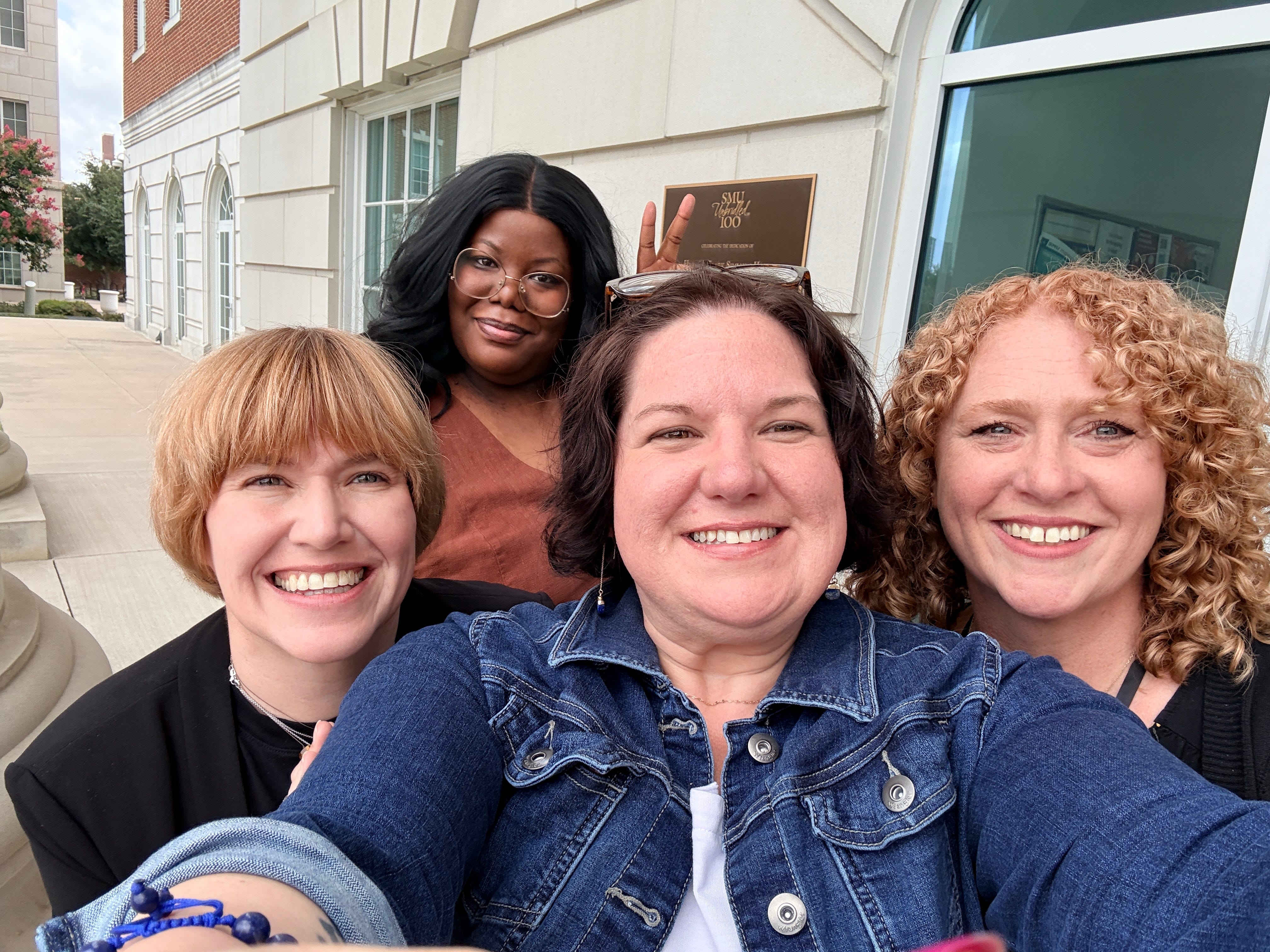

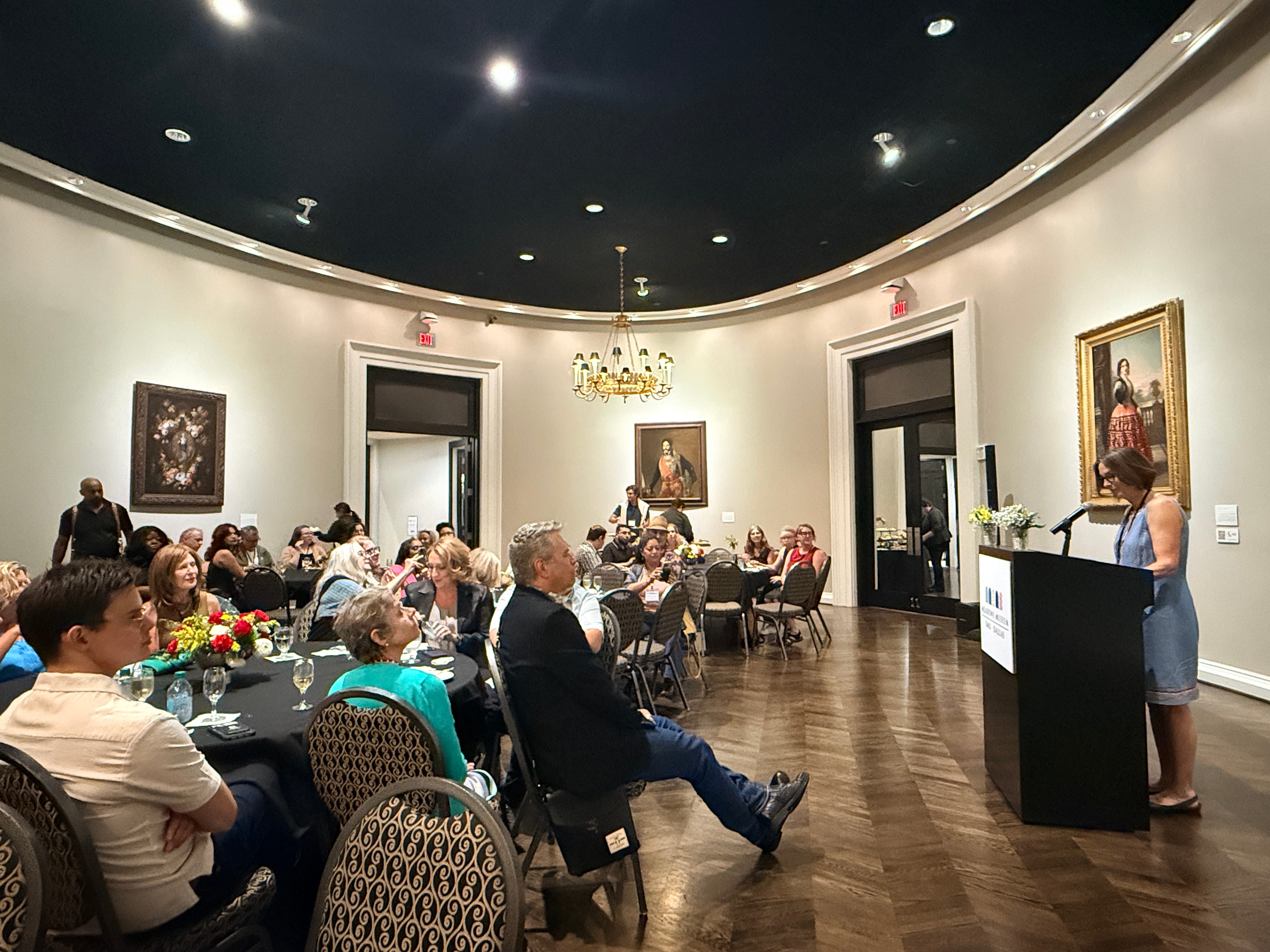
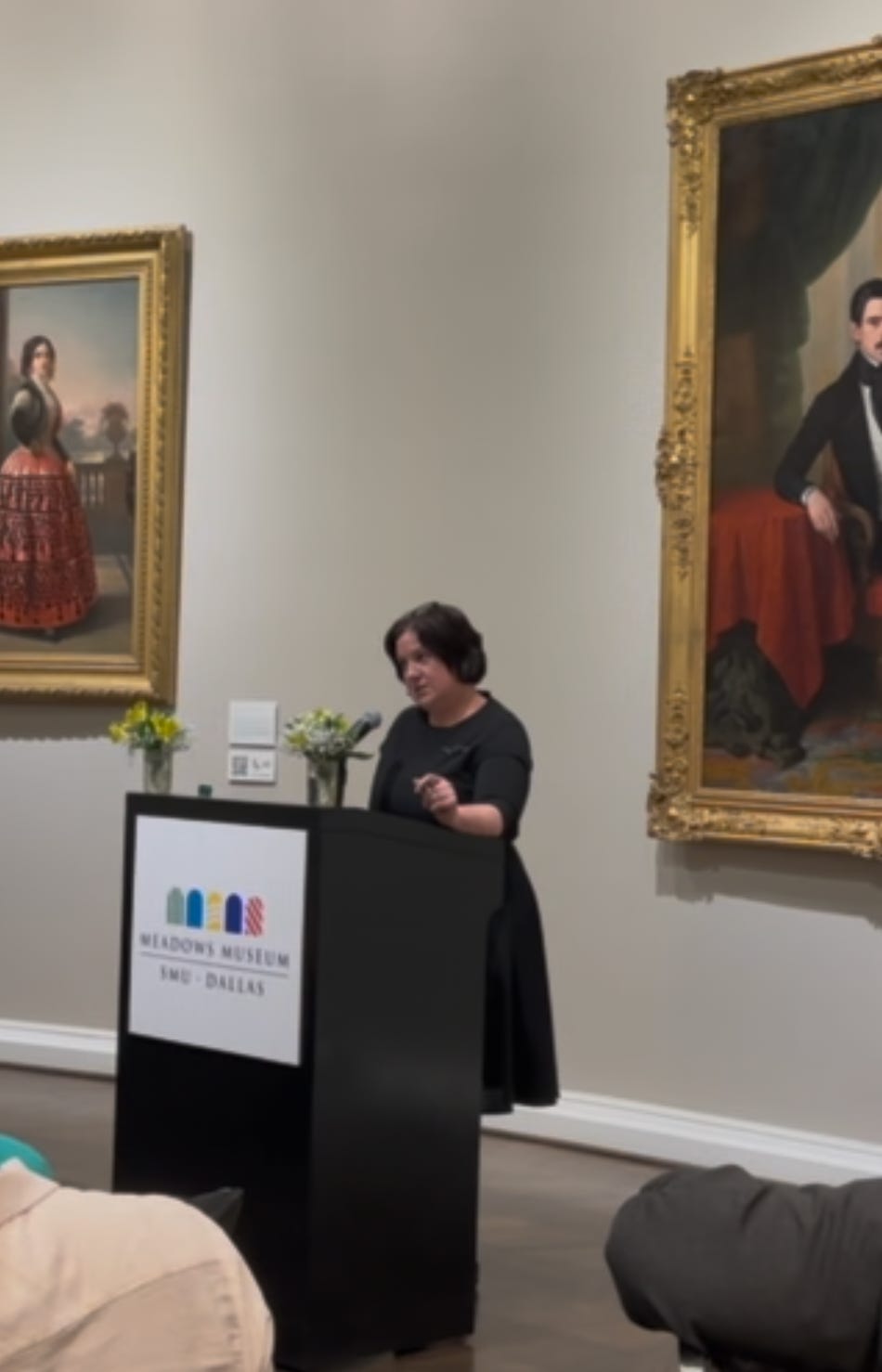
Thursday night, I read my work, Necessary Revisions, during the Creative Writing Spotlight at the 2026 Association of Graduate Liberal Studies Programs Annual Conference (AGLSP). The reading took place at the Meadows Museum at SMU in Dallas, TX—surrounded by art and the elegant beauty of a space that made the evening feel both intimate and momentous. The writing spotlight followed the presentation of the AGLSP Faculty Award to poet, professor, and former Dallas Poet Laureate Mag Gabbert, who has also been one of my professors.
I was terrified to share my creative writing before nearly sixty graduate and doctoral students, AGLSP board members, faculty, administrators, and scholars representing universities from across the country—including my advisor, Dr. Kate Montgomery, an AGLSP board chair and the founder of SMU’s graduate and doctoral Human-Centered Interdisciplinary Studies programs.
It was all worthwhile. In the hours and days that followed, several people approached me to share how personally the story had moved them. I had not expected that response. I received their words with gratitude and a deep sense of honor.
Necessary Revisions is about the identities written onto us—and the moment we recognize that, even when we did not choose the page, the next sentence may still be ours to write.
*Many thanks to fellow scholar, conference organizer, and friend Lue Kraltchev for recording this moment.
Necessary Revisions:
A Story of Reclaiming the Next Sentence
A woman sits at her kitchen table with a cold cup of coffee—living inside a script she never would have auditioned for. Morning light falls through the window at the same angle it always does. Somewhere beyond her knowing, a sentence is being written:
She rose, as she always did, and resigned herself to another predictable day.
She knows her days like a dark hallway: by the arguments before noon, the apologies she offers though she’s done nothing wrong, the smallness she folds herself into because the story never changes.
But this morning, something snags. She hears something like a page turning.
Then—a key turns in the lock.
He enters without knocking, as though leaving her had not revoked his claim to her space. He drops his things on her table and begins the old recitation of everything she has done wrong.
Above her head, gathering like a storm cloud, she sees the sentence she has lived inside for years:
She apologized, to keep the peace.
She had never noticed the pen writing these words. She was never meant to. But today, she looks anyway. Reaching up with the full weight of her attention, she takes hold of the pen and strikes through the sentence:
“This is my home,” she says. “You need to leave.”
The words don’t vanish. They edit.
The sentence wavers. The ink hesitates. And she learns the most powerful thing a character can know:
The manuscript isn’t finished.
He stares at her. She always lets him come back. So, he reaches for the script that has always worked—the familiar names. The words rise off his tongue and circle her:
Dramatic. Selfish. Delusional.
Each word hovers, waiting to be inked into her margins. She crosses them out. All of them. And writes in their place:
Courageous. Deliberate. Capable.
“No,” she says again. “Leave.”
The door closes behind him. Her hands are shaking—but she keeps hold of the pen. Somewhere in the story’s deep machinery, something pauses, as if the ink itself has felt her hand.
And then she notices the others.
They are everywhere. In offices. In grocery stores. In cars at red lights, searching for the sentence they can no longer bear to live inside. Characters moving through stories they didn’t choose, speaking dialogue handed to them by old fears and inherited stories.
The man who believes he is the failure his father named him.
The young girl already learning to shrink inside her sentences.
The friend living in a plot called too late for me.
She wants to grab every pen—to tear through every false ending, to cross out every cruel word over every bowed head.
But she can’t. This is the part she learns slowly: the pen cannot be wielded for another. It can only be revealed to them.
Instead, she asks:
Who wrote that sentence you keep repeating about yourself?
Who benefits when you believe it?
What would you write instead?
She watches realization land. The flicker. The pause. The margin thinning between what they were told and what they know. She watches for the instant when a character looks up from the page and understands:
The pen had always been theirs, even when the page was not.
One by one, they begin with small words, then whole chapters. The story changes as they begin to claim a voice within the pages.
This manuscript is still being written. It always will be. That is its nature, and ours.
She stands by the kitchen table, the morning light still falling through the window—though now she sees it from a different angle.
The coffee is warm. The page is open. She lifts the pen.
And for the first time, she knows the next sentence is hers to write.