

While the Rose Blooms
Between the Eternal Song & the Void

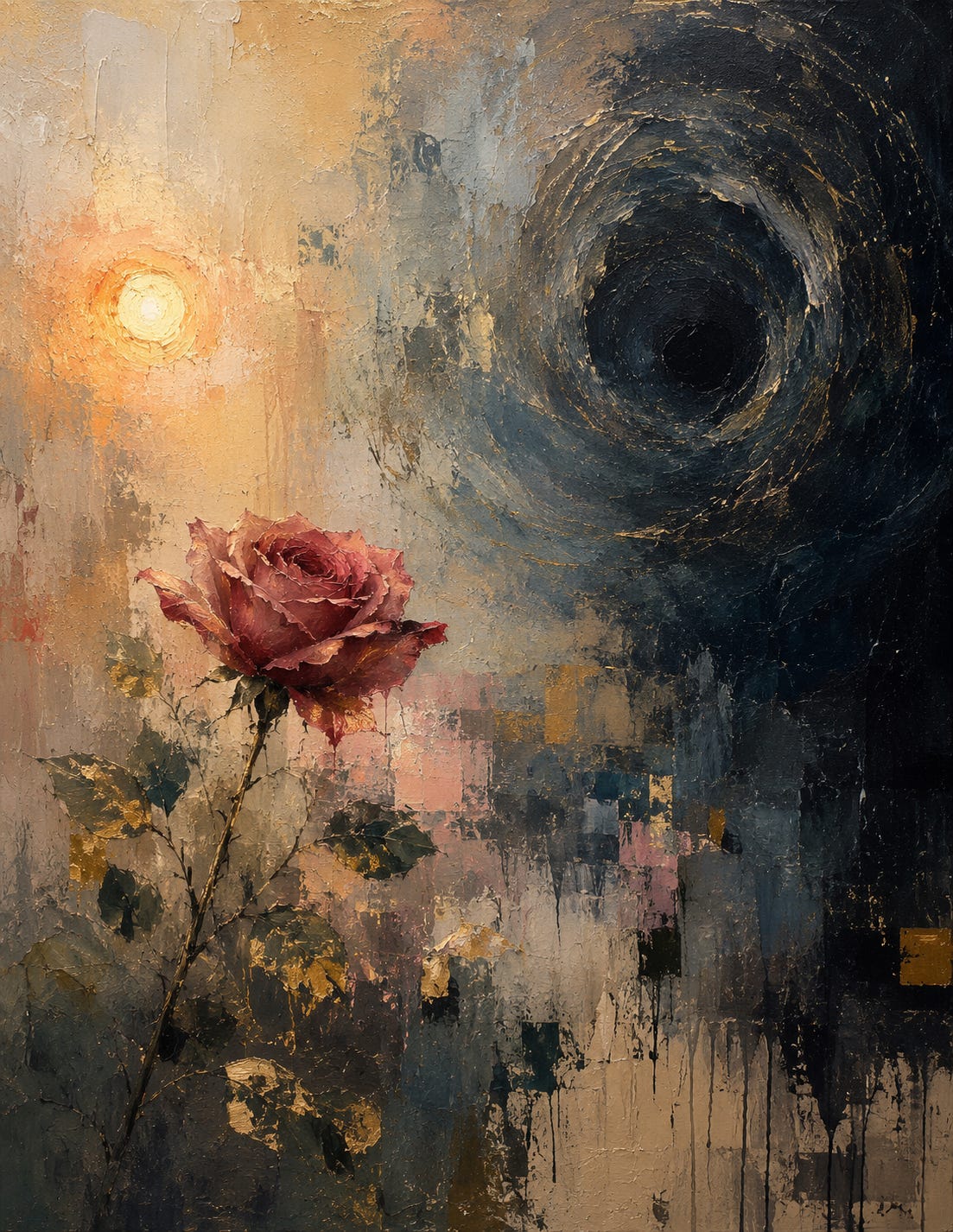
While the Rose Blooms:
Between the Eternal Song & the Void
Success can be deceiving.
From the surface, life may look like a flourishing rose garden—each bloom the visible result of years spent tending, pruning, watering, and waiting. Yet beneath every blossom lies a root system hidden from view. What appears beautiful above the soil was first formed in darkness.
A seed does not awaken in the light. It germinates beneath the earth, where hope can feel impossibly far away. It breaks open in darkness before it ever reaches the sun. Only after surrendering the form it once held does it begin to grow toward a light it cannot yet see. The richness of the soil, the warmth of the earth, the rain, the sun, and even the shade become part of what allows it to rise.
Every bloom is temporary. The petals eventually dry and drift toward the ground. Autumn, then winter arrive as faithfully as spring and summer. Life gives way to death, and death prepares the ground for life again. There is beauty in this rhythm—in the endless dance of rising and returning.
Even so, beauty does not erase sorrow.
There are moments when I cannot escape the grief of knowing that every life, every love, every masterpiece, every conversation reaches us through consciousness constrained by time.
There is something heartbreaking about how briefly we are permitted to witness the bloom. No matter how carefully we tend the garden, we cannot keep the petals from falling.
Still, there is something deeper stirring beneath this cycle.
As life and death dance in eternal rhythm—I sense an ancient song moving beneath the roots, a pattern woven through all living things that we rarely perceive. It’s the under-song that stirs the seed before it sprouts—that contains the patterns of all creation, the current running beneath birth and decay.
The bloom is but one verse.
The song existed long before the flower opened, and it continues after the petals have fallen. The song doesn’t exist in isolation.
Holding it is a vastness I can only call the void. It’s not simply darkness. Darkness is something we can perceive. The void is nothingness—an emptiness so complete that it can contain everything without becoming what it holds. It must remain empty to hold what is.
There’s a distinction between what is and what is not—though it’s not divided neatly.
Love is. Life is. The golden light that passes between human beings is. The hand held in grief, the face turned toward the sun, the fragile bloom opening despite the certainty of its death—these things are real. They belong to existence.
The void is the vastness of what is not.
It does not glow. It does not comfort. It does not sing. It exists alongside the light in its own truth—equally encompassing and equally eternal. It’s difficult to describe with precision.
I don’t believe we must diminish its existence by insisting that it’s secretly fertile, benevolent, or waiting to be something else. Its emptiness has its own truth.
There are times when I can stand near this vastness and feel wonder. I can sense the strange grandeur of being alive within something so immeasurable, unknown, and unseen. I can sense something beyond ordinary silence, the collapse of time, the weight of an absence past what language can describe.
I can accept that the void makes room for form, that silence allows the song to be heard, that emptiness is where space and time arise.
There are other times, though, when I glance too long into this vastness. Nietzsche warned that whoever gazes long into an abyss will find the abyss gazing back. I've come to believe he was describing the same encounter from its other side. What he framed as danger, I recognize as meeting. The psyche and the void are not strangers—the ache within us is an echo of the emptiness we behold.
Yet even a true meeting can overwhelm. Instead of feeling spacious, the vastness becomes absolute. Instead of making room for life, it seems to swallow life whole. The smallness of one human existence becomes unbearable against its scale. Meaning begins to fade.
The beauty of everything in concert remains before me—but I can no longer feel the beauty of the ancient melody. The emptiness that holds everything begins to resemble emptiness alone.
Cycles begin to feel futile.
There’s a sadness there that reaches beyond ordinary grief. It is not simply depression, although it may sometimes resemble it. It is an eternal ache—the sorrow of perceiving impermanence without being protected from its full weight.
It’s the realization that everything we love will pass, and that consciousness allows us not only to experience beauty but to know, even while beholding it, that it cannot remain—and that we are all verses in this eternal song.
We too are roses, experiencing seasons.
This knowledge can create a kind of existential vertigo. I stand between the radiance of what is and the vastness of what is not, unable to deny either one. Love feels infinite when I am inside it, yet the void appears equally infinite when I turn toward it.
Peace doesn’t come from forcing these opposites into reconciliation—the task is not to transform nothingness into hope or to insist that every darkness holds a hidden light. Perhaps it’s simply to grow capable of holding the balance without collapse—to recognize the void without surrendering to it, and to love the cycles of the garden without pretending its blooms will never disappear.
The flower does not defeat the cycle or the void outside of it by blooming—nor does the void make the flower meaningless. For one brief moment, the rose opens. Its color enters the world. Its fragrance moves through the air. It becomes fully what it is, even as autumn waits within it.
And maybe this is what it means to live honestly—to feel the eternal ache without turning away, to receive the golden light of love without demanding that it save us from impermanence, to bravely stand between everything and nothing with our hearts still open.
Perhaps the weight of this knowing is the cost of sensing life within the context of space and time—of standing on the threshold between.
Petals will fall. The cycle and song will remain. And still, despite it all, roses will bloom again.
🥀
I hope you’ll join me for the next Women’s Perspective Live conversation on Saturday, July 25 at 11am Central Time. I’ll be talking about women’s wellness, natural approaches to building healthy habits, and what it means to care for ourselves with both compassion and intention.
Join us Live Saturday, July 25 at 12pm Eastern / 11am Central: https://open.substack.com/live-stream/289526?utm_source=live-stream-scheduled-upsell


Really inspired by your writing!
Beautiful, true, great writing. Thank you.